

I am glad you are interested in what the TurnItIn score means. There is much confusion around the similarity score. I recently worked with a student who did not understand the report results. I am posting this to help others understand what the TurnItIn score means.
How TurnItIn Compares Your Submission
TurnItIn compares your submission to:
-
Billions of web pages: Both current and archived internet content.
-
A global student repository: Papers previously submitted to Turnitin by students worldwide.
-
Premium academic content: Thousands of leading periodicals, journals, and publications.
According to TurnItIn (2026a).
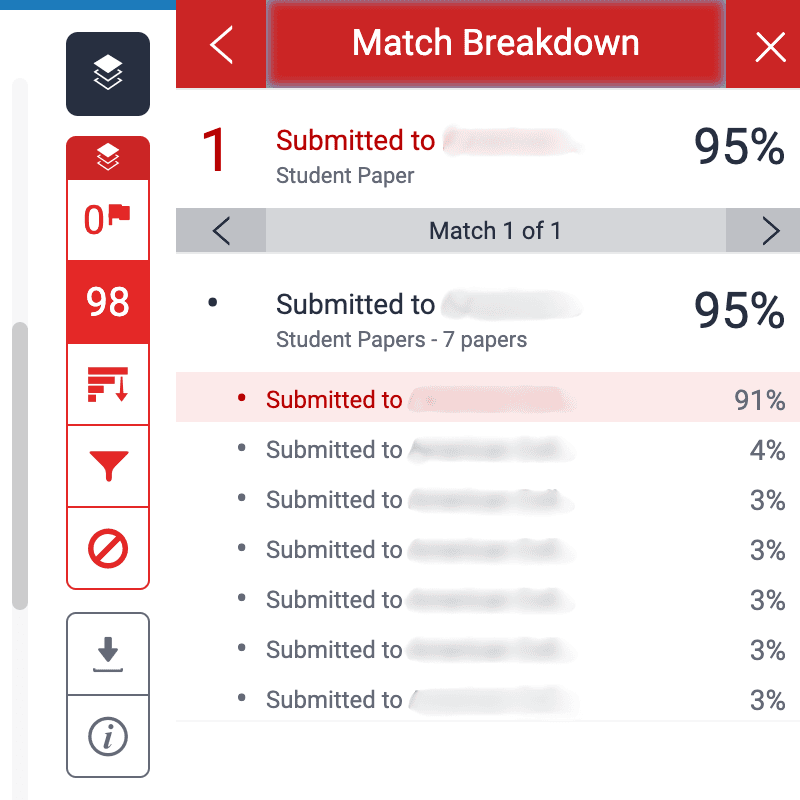

If the institution you attend uses TurnItIn, your submissions are included in the “papers previously submitted to Turnitin.” Be aware that your submissions are compared to your prior submissions at your current institution, your submissions at other participating TurnItIn institutions, and the submissions of others at TII participating institutions. TurnIt In has deep access to published content online; likely more than you are able to ever consume from your institution’s library. And finally, your submissions also are compared to printed content on the broader Internet, meaning especially any websites which are sharing course content – so be thoughtful.
In this student result from TurnItIn (left), the student has a 95% similarity score. This should spark curiosity of the student, it certainly will for the instructor.
Note that this score has a 95% similarity to 7 other student papers; this happened to be due to a format/template within the paper.
The 91% similarity was to the same student’s discussion board post. According to the rules of your institution this could be described as “self-plagiarism.” The American Psychological Association (APA, 2026) states, “If you use an author’s words directly, even your own words from a previous paper, you must use quotation marks (in addition to an in-text citation containing the author, year, and page or other location information of the quote) to let readers know that these are not your original words.”
TurnItIn explains what their Similarity Score means.
TurnItIn uses Color
TurnItIn uses color to denote the originality of a submission. If your submission returns a red mark upon submission, there are somethings to check.
But do not panic. Red does not always equal trouble. Check with your instructor. The red may be due to the use of a template or a revision to a prior submission.
What to do when TurnItIn Flags a Submission?
Your responsibility as the student is to be sure you are attributing the ideas in your submission to the originator. In this case, citing yourself!
If this student had made an effort when they noted the red tag from TII and the high percentage of simlalrity, they most likely would have been able to work wth their instructor. If you find yourself in a similar situation be cweratin to reach out to your instructor as soon as possible to underscore your good-intent and verify if there is any issue you may need to resolve.
References
American Psychological Association. (2026). Avoiding plagiarism guide. https://apastyle.apa.org/ instructional-aids/avoiding-plagiarism.pdf
TurnItIn (2026a) https://helpcenter.turnitin.com/hc/en-us/articles/27811925295501-Does-Turnitin-check-for-plagiarism-and-what-is-a-good-Similarity-score